RISE glossary
Every term in the RISE Business Framework, defined in a sentence or two. Each one links to its full page, with the RISE tool rebuilt on the page.
0-9
- 1-Year Target
- A one-year target is the goal your business commits to reaching in the next twelve months. It keeps the team motivated and on track.
- 3-Year Projection
- A three-year projection is a picture of where your business will be in three years. It helps you chart an ambitious but achievable path.
- 9-Box
- A 3-by-3 grid that rates items on two axes, with a named cell and a prescribed action for each box. RISE uses it for talent (potential and performance), culture (trust and alignment), processes and products.
- 90-Day Sprint
- A 90-day sprint is a short, focused period for hitting a quarter of your yearly goal. The short window creates urgency and sharpens priorities.
A
- A/B Testing
- A/B testing, also called split testing, compares two versions of a message, page or campaign to see which performs better. In RISE, you test current strategies against new methods.
- Advertising
- Advertising is paying for or earning attention to put your message in front of more people. It amplifies your marketing.
- Analyzing a Product
- Product analysis is judging each product's strengths, weaknesses, audience and position before you market it. In RISE, you place every product on a 9-Box.
- Art of Delegation
- Delegation is handing a task and its responsibility to someone else. RISE frames it as a diagnostic the leader applies per task and per person.
B
- Behavioral Assessment
- A behavioral assessment measures what drives a person and how they tend to act at work. In RISE it is the Head.
- Brand Audit
- A brand audit is a review of how your brand looks, sounds and performs against competitors. It examines messaging, visuals, customer perceptions and the competitive landscape.
- Brand Feeling
- Brand feeling is the emotional response your company or product creates in its audience. It comes through visuals, messaging and every touchpoint.
- Brand Guide
- A brand guide is a reference document that shows how your brand should look and sound. It covers mission, values, tone of voice, visuals and messaging.
- Brand Insistence
- Brand insistence is when customers want your brand specifically and keep it top-of-mind when buying or recommending. In RISE, it is built through four drivers.
- Branding
- Branding is how people recognize, remember and feel about your business. It covers visuals, messaging and every customer touchpoint.
- Budgeting
- An advertising budget sets how much you will spend, where, and what success looks like. In RISE, you plan the total cost of each ad, including design, production and media.
- Budgets
- A business budget is a plan for how income will cover expenses, savings and investments over a period. In RISE, you first determine total income and expenses, set money aside, then allocate the rest by short-term priority.
- Business Pipeline
- A business pipeline is the full path work and money travel through your business, from customer acquisition to referral. RISE maps it with four tools.
C
- Cash Conversion Cycle
- The cash conversion cycle (CCC) measures how efficiently a company turns its resources into cash. It covers the time to purchase inventory, sell it and collect from customers.
- Channels
- Advertising channels are the places your message runs, such as social media, search, email, direct mail or events. Each has strengths and weaknesses.
- Consistency
- Advertising consistency means every ad, on every channel, carries the same message and look. In RISE, you use the same visuals, colors and fonts everywhere so ads tell one unified story.
- Consumer Psychology
- Consumer psychology is the study of the thoughts, feelings, motivations and behaviors behind buying decisions. In RISE, a matrix crosses four consumer mindsets with four spending categories.
- Core process
- A process the business depends on. In RISE every core process has one accountable owner on the Process Ownership Chart.
- Critical role
- A seat the business cannot afford to leave empty. RISE scores each critical role on five succession criteria; any role totalling above 10 is addressed immediately.
- Culture
- Company culture is the way things are done in a business. RISE designs it with four affirmations.
- Culture Meetings
- A culture meeting brings the team together to reinforce values, purpose and shared goals. In RISE, the Culture Meeting is held quarterly and reviews the Key Purpose Indicator.
- Cycle Time
- Cycle time is the time it takes to complete a task or process from start to finish, including waiting time and other delays. RISE layers it onto the SIPOC.
D
- Desire Assessment
- A desire assessment measures whether a person genuinely wants a role, not just whether they can do it. In RISE it is the Heart and always comes first.
- Develop & Evaluate
- Developing and evaluating employees means regularly measuring performance and acting on what you find. RISE uses the 9-Box with a prescribed action for each box.
E
- Earn the right to engage
- RISE's rule for timing growth: score 10 or more out of 12 in Resources, Inspiration and Systems before investing heavily in branding, marketing, advertising and sales.
- Effective Meetings
- Effective meetings are scheduled, structured meetings where problems get solved, tasks get assigned and progress gets measured. RISE runs four meeting types on a set rhythm: Culture and Strategic meetings quarterly, Organizational meetings weekly, and Tactical meetings daily and weekly.
- Encourage & Recognize
- Encouraging and recognizing employees means investing time and money in the people who drive results. RISE teaches this with a $100 talent budget spread across the 9-Box.
- Engagement quadrant
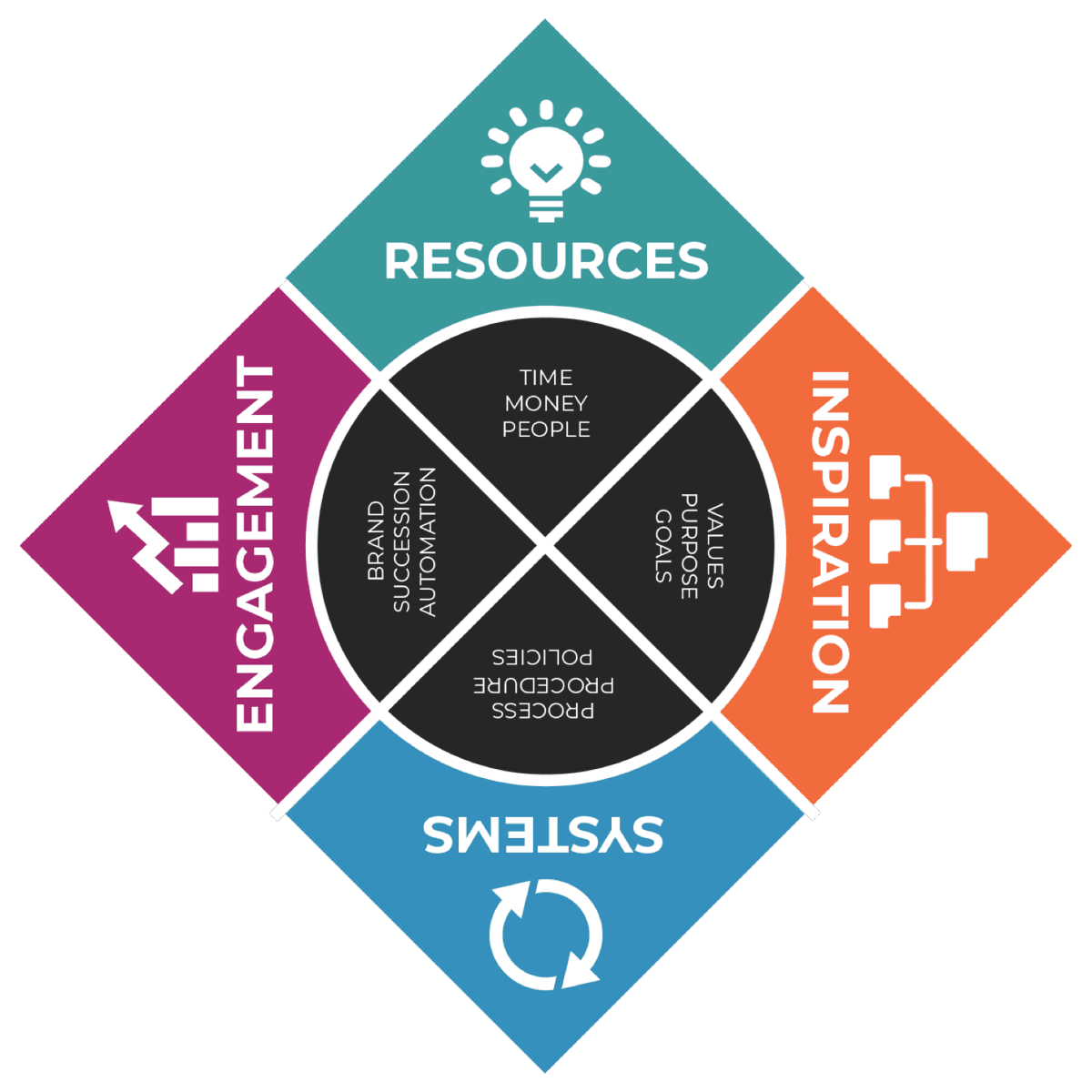
- Engagement is the fourth quadrant of the RISE Business Framework. It expands the business through branding, marketing, advertising and sales, using profits earned in the first three quadrants.
- Engaging Customers
- Customer engagement is the ongoing, personal contact that moves a prospect toward buying and buying again. In RISE, you sell the way customers prefer, through channels like email, SMS or chatbots.
F
- Finance
- Business finance is planning, recording and reviewing the money that flows through your company. RISE treats it as a four-step cycle.
G
- Goal Affirmation
- Goal affirmation is setting one revenue goal tied to your purpose and confirming it is worth pursuing. RISE starts with the revenue goal needed to fulfill your purpose.
- Growth Plateau
- The flat stretch a business reaches when the work of its current quadrant is done. RISE treats a plateau as a launching point: growth resumes when the next quadrant begins.
H
- Heart, Head, Hands, Feet
- RISE's four talent assessments, run in this order: Desire (heart), Behavioral (head), Skills (hands) and Mobility (feet). Desire comes before skill.
- Hire & Onboard
- Hiring and onboarding is selecting the right person and setting them up to succeed from day one. In RISE, you use the 9-Box at this stage to name where a candidate or team member sits.
I
- Identify Company Purpose
- A company purpose is the reason a business exists beyond making money. RISE identifies it with the Company Purpose Statement worksheet.
- Identify Core Values
- Core values are the principles that guide how a business makes decisions. RISE identifies them with a four-step exercise.
- Identify Key Purpose Indicator
- A Key Purpose Indicator is a measurable target tied to why a business exists. In RISE, KPI here means Key Purpose Indicator, not Key Performance Indicator.
- Identify Personal Purpose
- A personal purpose is the reason behind what you do each day. It gives direction and an anchor when times are tough.
- Importance of Leadership
- The importance of leadership is the difference good direction makes to a team's results. RISE defines it with a five-part model.
- Inspiration quadrant
- Inspiration is the second quadrant of the RISE Business Framework. It is the why behind the business: leadership, core values, a purpose beyond making money, a designed culture, and dated goals from a 3-Year Projection down to a 90-Day Sprint.
- Inspiring a Sales Team
- Inspiring a sales team means creating an environment where salespeople stay motivated and engaged. In RISE, managers recognize achievements, hold scheduled feedback sessions and set clear performance goals.
K
- Key Performance Indicators
- Key Performance Indicators are measures of business results. In RISE they are tracked weekly by function, with owners in Marketing, Sales and Finance.
- Key Process Indicators
- Key Process Indicators are daily measures of process activity and defects. RISE tracks them by department across Marketing, Sales, Operations and Finance for days 1 through 5.
- Key Profit Indicators
- Key Profit Indicators are the core measures of a company's financial health. RISE tracks four, owned by the CFO: Revenue, Profit Margin, Cash on Hand and Cash Conversion Cycle.
- Key Purpose Indicators
- A Key Purpose Indicator is a clear measurement that your business is accomplishing its purpose beyond making money. RISE derives it from your purpose statement.
L
- Leadership
- Leadership is setting direction and moving people toward it. In RISE, it is the first pillar of the Inspiration quadrant.
- Leadership Audit
- A leadership audit is a regular review of how you are leading. RISE makes it a weekly habit built on four simple questions.
- Leadership vs Management
- Leadership sets direction and inspires people. Management organizes the work so the direction gets delivered.
- Long-Term Vision
- Long-term vision is a clear, lasting answer to why your business exists. In RISE, it is built from four pieces.
M
- Marketing
- Marketing connects your brand to the people most likely to buy. It covers what you sell, who buys it, and how you reach them.
- Metrics
- Advertising metrics are the numbers that show whether your ads work. Common ones include click-through rate, cost per click, cost per acquisition and return on investment.
- Mission Affirmation
- Mission affirmation is confirming that people's personal purpose can be fulfilled by helping achieve the company's purpose. RISE also calls it Belief Affirmation.
- Mobility Assessment
- A mobility assessment gauges a person's potential to grow into future roles. In RISE it is the Feet and comes last.
O
- Organizational Chart
- An organizational chart is a diagram of a company's structure. It shows departments, roles and the chain of command, so it is easy to see who has authority over which areas.
- Organizational Meetings
- An organizational meeting is a weekly leadership meeting that links quarterly goals to daily work. In RISE, it reviews the Key Performance Indicator report and The Four.
P
- P&Ls
- A profit and loss statement, or income statement, reports a business's revenue, expenses and net gain or loss over a set period. In RISE, the P&L uses the same line items as the Pro Forma in a single actual-period column.
- People Affirmation
- People affirmation is deciding who strengthens your culture and who weakens it. RISE uses a 9-Box.
- Pipeline
- A pipeline is the sequence of steps work moves through from start to finish. RISE speeds it up with an eight-stage wheel: Baselining, Identify, Organize, Standardize, Redesign, Automate, Apply Metrics and Cross Train.
- Policy Timelines
- A policy timeline pairs a policy, which frames decisions, with a timeline that directs action. Together they show people what is expected and how to manage their time.
- Position Affirmation
- Position affirmation is confirming each person is in a role where they can succeed. RISE uses a 9-Box with performance on the horizontal axis and potential on the vertical axis.
- Pro Formas
- A pro forma is a financial projection built on assumptions about future sales, expenses and capital spending. It shows whether a business will stay profitable over time.
- Procedure Guides
- A procedure guide outlines the steps needed to complete a task so employees produce consistent, quality results. RISE procedure guides have ten numbered steps.
- Process Commitment
- Process commitment is a team member's dedication to consistently following a process toward its goal, even when obstacles arise. RISE checks it with four questions asked seat by seat.
- Process Execution
- Process execution is how consistently your business carries out its work the same way every time. RISE builds it in four steps.
- Process Mapping
- Process mapping is a technique for visually mapping out workflows, also called a flowchart or workflow diagram. RISE maps each step with who is responsible, how long it takes and the tools required.
- Process Ownership Chart
- A process ownership chart shows who is accountable for each process in a business, not just who reports to whom. RISE uses a four-tier cascade.
- Productivity Studies
- A productivity study analyzes how tasks are completed, what resources are used and how long each step takes. RISE uses a weekly time study.
R
- Recruit & Attract
- Recruiting and attracting talent means making your open role more appealing than competing positions. In RISE, you pick a position of need and score it 1-3 against similar positions on ten factors, from Challenge to Brand.
- Resources of Sales
- Sales resources are the people, tools and training a team needs to work leads and close deals. In RISE, a WHO, WHAT, HOW, WHEN worksheet defines the sales team, its tools, its compensation and its weekly training schedule.
- Resources quadrant
- Resources is the first quadrant of the RISE Business Framework. It covers the time, money and people that turn an idea into a business: who owns what, whether the right person is in each seat, how people are developed, and whether the finances are clean.
- RISE Business Assessment
- A free 16-statement assessment, four statements per quadrant, each rated from 1 (not yet) to 3 (dialed in).
- RISE Business Framework
- The RISE Business Framework is a business operating framework built on four quadrants (Resources, Inspiration, Systems and Engagement), each with four topics and four subtopics, 64 units in all.
- RISE Business Lifecycle
- The path a business follows through the four RISE quadrants in a fixed order: Resources, Inspiration, Systems, Engagement. Each quadrant's exit condition is the next quadrant's starting point.
- RISE Percentage
- A company's overall RISE Business Assessment result: the total of all 16 ratings divided by 48.
- Rule of 7
- The RISE rollout principle that team members need to hear a message at least seven times before it sinks in.
S
- Sales
- Sales is turning leads into paying customers. It is where branding, marketing and advertising become revenue.
- Seat
- A role in the business that one person fills. RISE asks the Process Commitment questions seat by seat.
- Short-Term Vision
- Short-term vision is the set of dated goals that move a business toward its long-term purpose. RISE builds it as a cascade.
- SIPOC
- SIPOC stands for Suppliers, Inputs, Process, Outputs and Customers. It is a one-page overview of a process that comes from Six Sigma and Lean.
- Skills Assessment
- A skills assessment checks whether a person has the knowledge, skills and experience a job requires. In RISE it is the Hands and comes third, after desire and behavior.
- Stoplight Reports
- A stoplight report is a scorecard that shows key numbers against their targets at a glance. RISE uses four of them, one for each type of KPI: Key Purpose, Key Profit, Key Performance and Key Process Indicators.
- Strategic Meetings
- A strategic meeting is where leaders set objectives and plan how to reach them. In RISE, the Strategic Meeting is held quarterly, not monthly, and reviews the Key Profit Indicator report.
- Succession Planning
- Succession planning is the process of preparing people to step into critical roles before those roles are vacated. In RISE, you score each critical role 1-3 on five criteria, such as urgent need and internal bench strength.
- Systems of Sales
- A sales system is the process and platform a team uses to manage leads, track performance and close deals. In RISE, you build a replicable process that includes follow-ups.
- Systems quadrant
- Systems is the third quadrant of the RISE Business Framework. It turns an inspired business into a streamlined machine through documented processes, procedures and policies, a meeting rhythm, a mapped business pipeline, and Stoplight Reports that track the numbers every team member owns.
T
- Tactical Meetings
- Tactical meetings are short, frequent check-ins on day-to-day operations. In RISE there are two.
- Talent Accountability
- Talent accountability means every person knows their role and every piece of work has a named owner. RISE builds it with four tools.
- Talent Development
- Talent development is the ongoing work of attracting, onboarding, growing and recognizing people. RISE runs it as a cycle: Recruit & Attract, Hire & Onboard, Develop & Evaluate, and Encourage & Recognize.
- Talent Optimization
- Talent optimization is matching people to roles using evidence instead of gut feel. RISE does it with four assessments run in a set order: Desire (Heart), Behavioral (Head), Skills (Hands) and Mobility (Feet).
- The Four
- Quarterly projects are the few initiatives a business commits to finishing in the next three months. RISE calls them The Four.
V
- Variance Reports
- A variance report compares planned financial results with actual results. In other words, it compares what was supposed to happen with what happened.
W
- Writing a Marketing Plan
- A marketing plan is a written outline of how your business will reach customers and expand into new markets. In RISE, the plan sets audiences, objectives, budget, competition, channels, a timeline and analytics.
Find out where your business really stands.
The free RISE Assessment scores your business across all four quadrants in about 6 minutes, and shows you where the opportunity is.