The RISE Business Framework
By RISE Business Framework · Created by Gary Harper and Brandon McCurdy · Reviewed
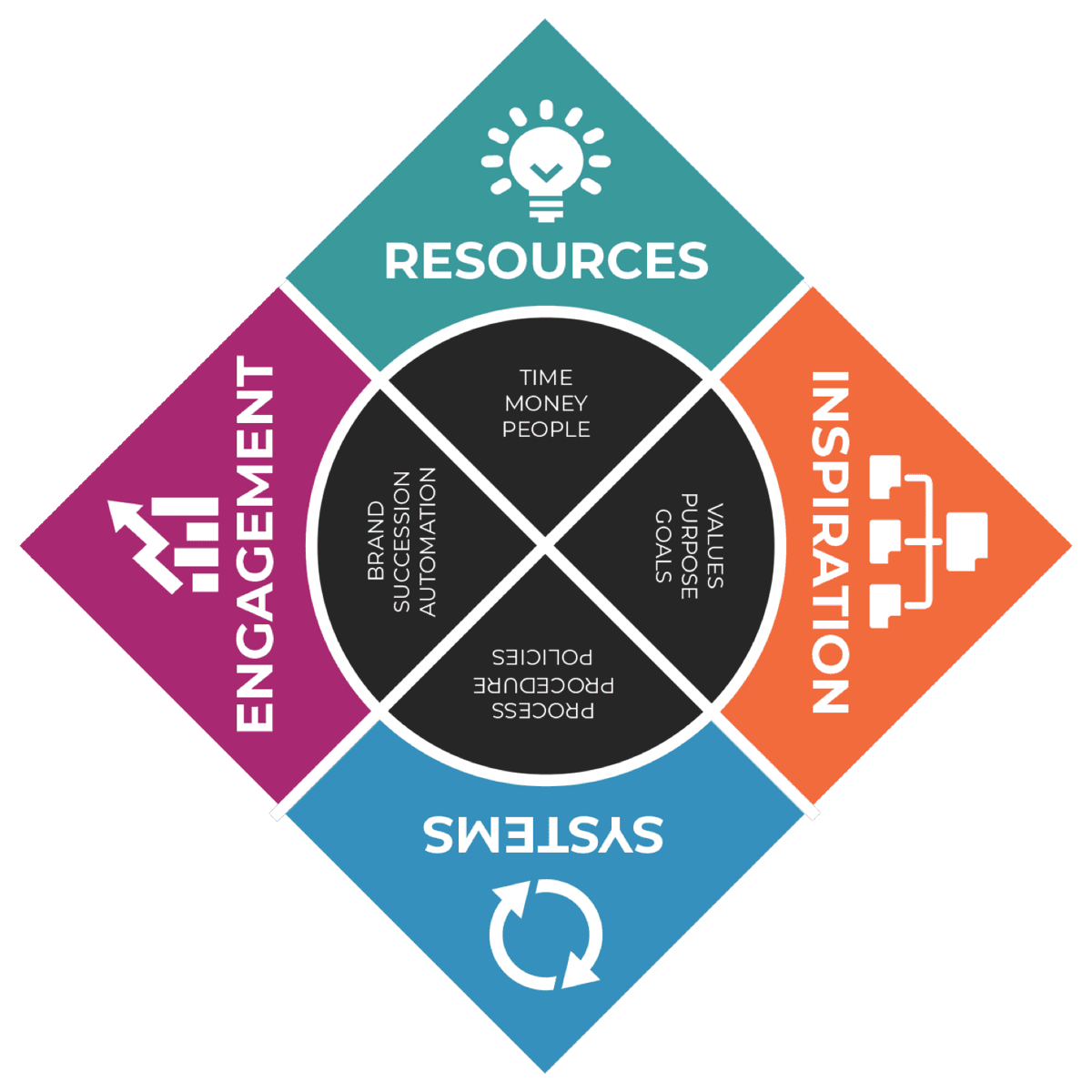
The RISE Business Framework is a business operating framework with four quadrants: Resources, Inspiration, Systems and Engagement. Each quadrant has four topics and each topic has four tools, 64 in all. Businesses build the quadrants in order, from becoming self-sustaining to expanding through brand, marketing and sales.
 Quadrant 1 of 4
Resources
Time • Money • People
The right people, roles, and finances to run and grow.
Led by Austin McCurdy
4 quadrants, 16 topics, 64 tools
Every topic below has its own page, with the RISE worksheet rebuilt on the page and a guided build in the AI RISE Coach.
Quadrant One · Time · Money · People
Resources
- Talent Accountability
Organizational Chart · Process Ownership Chart · Process Commitment · Succession Planning
- Talent Optimization
Desire Assessment · Behavioral Assessment · Skills Assessment · Mobility Assessment
- Talent Development
Recruit & Attract · Hire & Onboard · Develop & Evaluate · Encourage & Recognize
- Finance
Pro Formas · Budgets · P&Ls · Variance Reports
Quadrant Two · Values · Purpose · Goals
Inspiration
- Leadership
Importance of Leadership · Leadership vs Management · Art of Delegation · Leadership Audit
- Long-Term Vision
Identify Core Values · Identify Personal Purpose · Identify Company Purpose · Identify Key Purpose Indicator
- Culture
People Affirmation · Position Affirmation · Goal Affirmation · Mission Affirmation
- Short-Term Vision
3-Year Projection · 1-Year Target · 90-Day Sprint · The Four
Quadrant Three · Process · Procedures · Policies
Systems
- Effective Meetings
Culture Meetings · Strategic Meetings · Organizational Meetings · Tactical Meetings
- Business Pipeline
Pipeline · SIPOC Diagram · Cycle Time · Cash Conversion Cycle
- Stoplight Reports
Key Purpose Indicators · Key Profit Indicators · Key Performance Indicators · Key Process Indicators
- Process Execution
Business Process Mapping · Procedure Guides · Policy Timelines · Productivity Studies
Quadrant Four · Branding · Marketing · Advertising
Engagement
- Branding
Brand Audit · Brand Feeling · Brand Guide · Brand Insistence
- Marketing
Analyzing a Product · Consumer Psychology · Writing a Marketing Plan · A/B Testing
- Advertising
Channels · Metrics · Budgeting · Consistency
- Sales
Resources of Sales · Inspiring a Sales Team · Systems of Sales · Engaging Customers
The RISE Business Lifecycle
RISE follows a business up a single curve over time. Each quadrant has an exit condition, and that exit condition is the next quadrant’s starting point.
1. Resources (Time · Money · People)
“An idea becomes a business when time, money, and resources are dedicated to bringing it to life. The resource quadrant is complete when a business is self-sustaining, can pay its own expenses and makes a profit each month.”
2. Inspiration (Values · Purpose · Goals)
“If we make it through the resource quadrant, we then measure profits, implement a business framework, and clearly define our purpose as a business beyond just making money.”
3. Systems (Process · Procedures · Policies)
“Our inspirational business is now ready to turn into a streamlined machine. We focus on documenting processes, creating procedures and instituting policies. We focus on the right systems and the right process.”
4. Engagement (Branding · Marketing · Advertising)
“Some businesses should stay in the systems quadrant, others can move into engagement. For engagement we must be willing to leverage the profits we made in the previous quadrants and invest it in brand, talent succession planning, and automations.”
Between each step is a growth plateau. RISE treats a plateau as a launching point, not a stall: it means the current quadrant’s work is done and the next one begins.
AI RISE Coach
Find your next quadrant with the AI RISE Coach
“Which RISE quadrant should my business work on first, and why?”
Frequently asked questions
What is the RISE Business Framework?
The RISE Business Framework is a business operating framework built on four quadrants (Resources, Inspiration, Systems and Engagement), each with four topics and four subtopics, 64 units in all. It was created by Gary Harper, Brandon McCurdy, Susan Harper and Austin McCurdy.
What does RISE stand for?
Resources, Inspiration, Systems and Engagement. Businesses build them in that order, and each quadrant's completion is the next one's starting point.
How is RISE different from other business operating systems?
RISE puts finance in the first quadrant (pro formas, budgets, P&Ls and variance reports), so owners run the business from real numbers. It also follows a business through four growth stages, each with its own tools and exit condition.
How do I know which RISE quadrant my business is in?
Take the free RISE Business Assessment. You rate 16 statements, four per quadrant, from 1 to 3. The lowest-scoring quadrant is usually where to start.
What is a growth plateau in RISE?
The flat stretch after a quadrant's work is done. RISE treats a plateau as a launching point: growth resumes when you start the next quadrant.
Comparing frameworks? Read RISE vs EOS, RISE vs Scaling Up and RISE vs OKRs, or look up any term in the RISE glossary.
Articles on the RISE Business Framework
Find out where your business really stands.
The free RISE Assessment scores your business across all four quadrants in about 6 minutes, and shows you where the opportunity is.