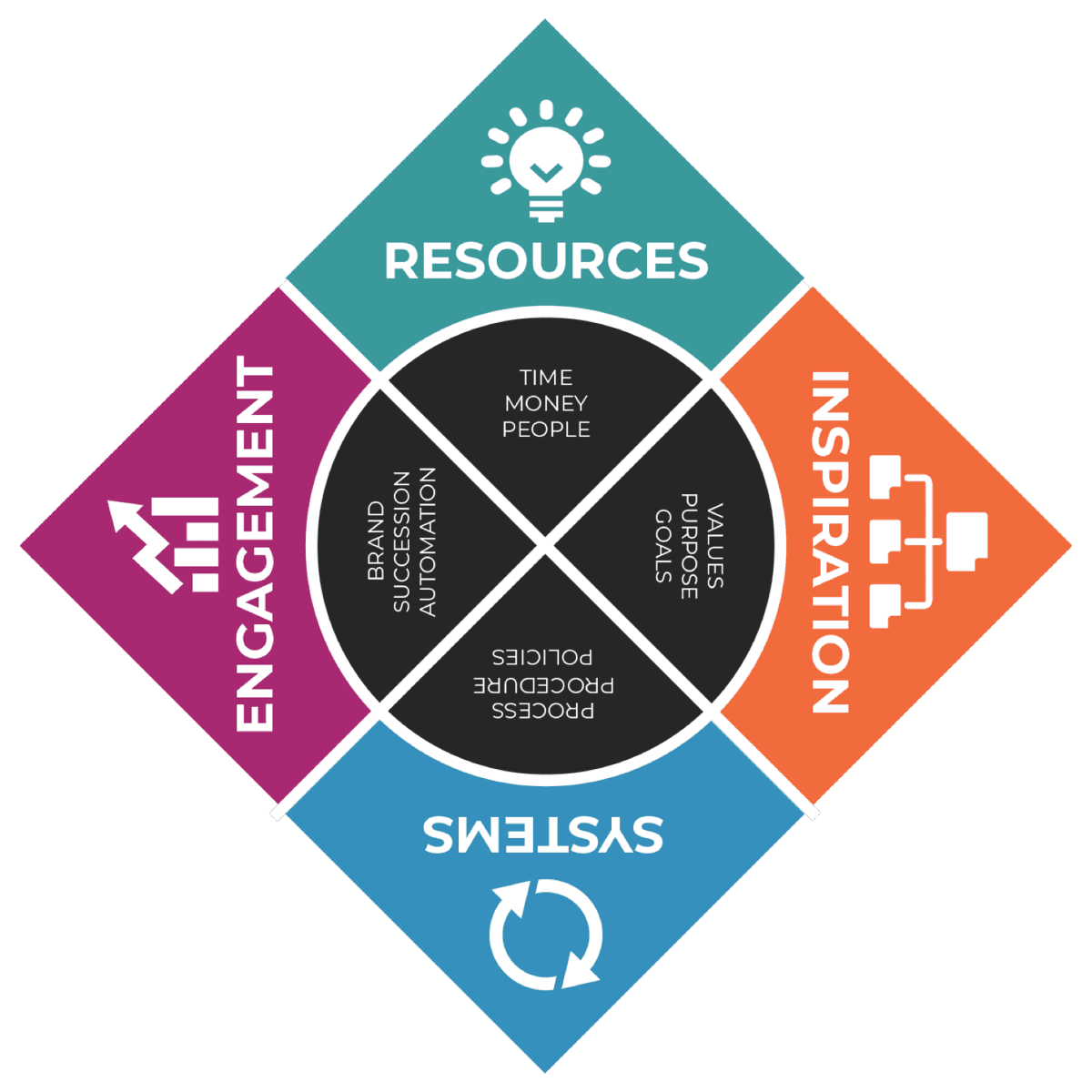
Inspiration · Topic 2 of 4
What is long-term vision?
By RISE Business Framework · Created by Gary Harper and Brandon McCurdy · Reviewed
Long-term vision is a clear, lasting answer to why your business exists. In RISE, it is built from four pieces. You identify core values, your personal purpose and your company purpose. Then you set a Key Purpose Indicator, a clear measurement that proves the business is accomplishing the purpose it was born to accomplish.
Key takeaways
- Core values come from a four-step exercise: Internalize, Categorize, Visualize, Verbalize.
- Personal and company purpose use the same past, present and future prompts.
- The company purpose statement produces a Key Purpose Indicator.
- In RISE, KPI here means Key Purpose Indicator, not Key Performance Indicator.
Long-Term Vision in the RISE Business Framework
Long-Term Vision is the second pillar of the Inspiration quadrant. It answers why your business exists beyond making money. Every other decision in the quadrant is derived from that answer.
The pillar moves from the person to the company. You define core values, then your personal purpose, then the company purpose. Finally, you set one Key Purpose Indicator that measures whether the purpose is being fulfilled.
Why long-term vision matters
Without stated core values, decisions depend on mood and personality. Hiring, firing and leadership style become inconsistent. Team members guess at what is expected of them.
Without a purpose, the only goal left is revenue. That rarely gives people a reason to stay through hard seasons. It also leaves the owner without an anchor when the business gets difficult.
“In entrepreneurship, core values are the non-negotiable tenets that underline what your business stands for. They're the compass guiding every decision you make.”Gary Harper
The 4 tools of Long-Term Vision
1 of 4
Identify Core Values
A four-step exercise that turns the people you admire into up to four actionable core values.
2 of 4
Identify Personal Purpose
Use past, present and future prompts to write your personal purpose statement.
3 of 4
Identify Company Purpose
The RISE Company Purpose Statement worksheet: what you love, your gift to the world and how you want to be remembered.
4 of 4
Identify Key Purpose Indicator
One clear measurement that proves your business is accomplishing the purpose it was born to accomplish.
How to build long-term vision with RISE
- 1
Identify your core values
List three impactful people and four words for each. Group the words, label each group and add a verb to each label.
- 2
Write your personal purpose
Answer three prompts: I love..., My gift to the world..., and I want to be remembered for.... Then write one statement.
- 3
Write your company purpose
Answer the same prompts as a business, with up to eight bullets per column. Distill them into one company purpose statement.
- 4
Set a Key Purpose Indicator
Choose one clear measurement that proves the business is accomplishing its purpose.
- 5
Share it with the team
Make sure every team member knows the core values and strives to keep them.
Quick self-check
“We have clearly defined core values that every team member knows and strives to keep.”
AI RISE Coach
Write your purpose statement with the AI RISE Coach
“Help me write our company purpose statement.”
Frequently asked questions
What is the difference between core values and purpose?
Core values describe how you act and decide. Purpose describes why the business exists. RISE defines values first, then personal and company purpose.
How do you create a long-term vision for a small business?
In RISE, you identify core values, your personal purpose and your company purpose. Then you set a Key Purpose Indicator to measure progress toward that purpose.
What does the RISE Business Assessment ask about long-term vision?
It asks whether you have clearly defined core values every team member knows. It also asks whether you have documented purposes for why the business exists beyond making money.
Related in RISE
- Leadership (Inspiration)
- Culture (Inspiration)
- Stoplight Reports (Systems)
- Branding (Engagement)
- The Inspiration quadrant
Further reading
- Make Your Values Mean Something (Harvard Business Review)
- Building Your Company's Vision (Harvard Business Review)
- Mission Statement: definition and examples (Investopedia)