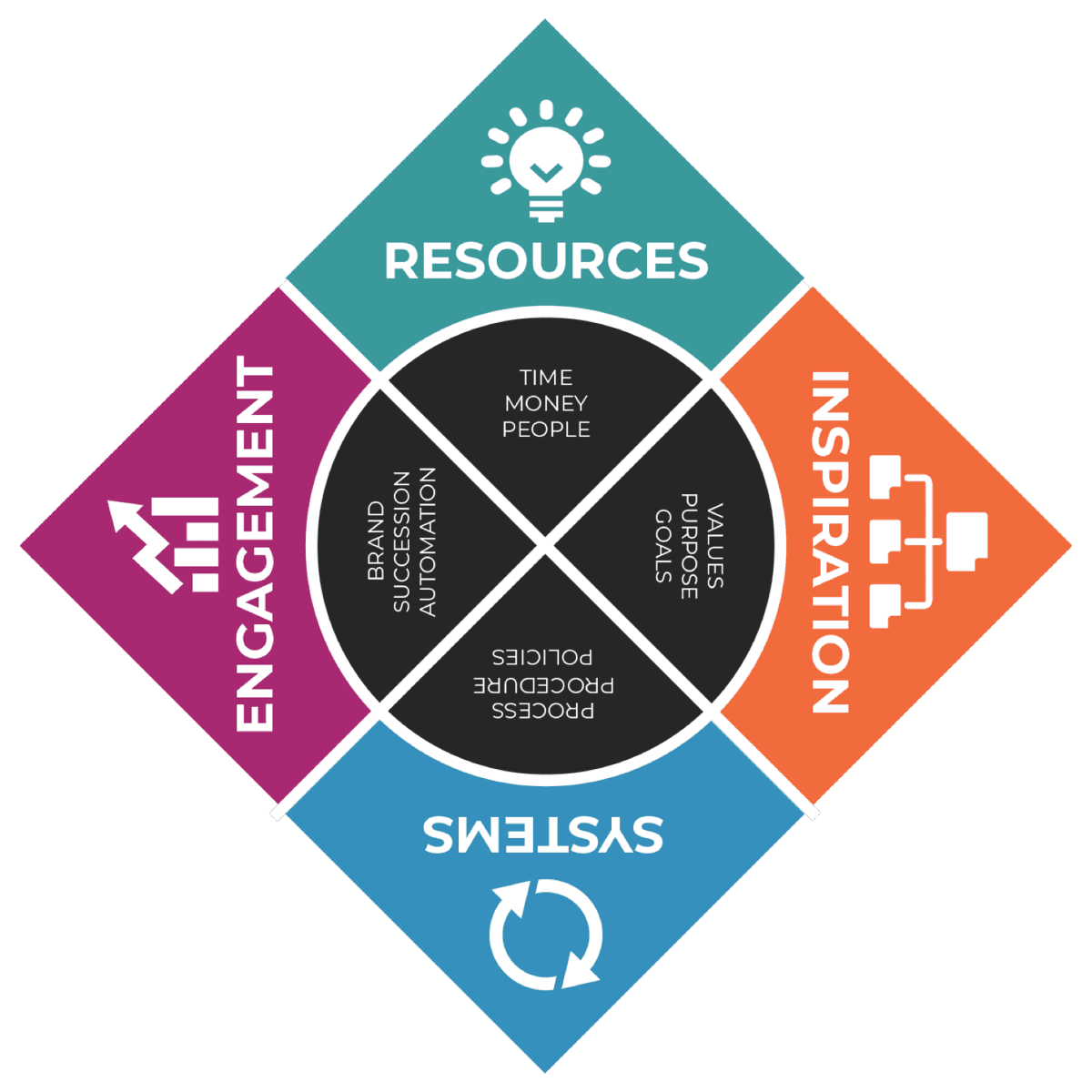
Systems · Topic 4 of 4
What is process execution?
By RISE Business Framework · Created by Gary Harper and Brandon McCurdy · Reviewed
Process execution is how consistently your business carries out its work the same way every time. RISE builds it in four steps. Map each process and score it on the 9-Box. Write ten-step Procedure Guides. Set Policy Timelines by priority. Run Productivity Studies to find wasted time.
Key takeaways
- Process maps use three symbols: Start/End, Decision Box and Process Step.
- The Process Mapping 9-Box scores each process on Valuable and Essential.
- RISE Procedure Guides have ten steps.
- Policy Timelines set a definition and target for High, Medium and Low priority.
- Productivity Studies track units per hour each weekday.
Process Execution in the RISE Business Framework
Process Execution is the fourth topic in the Systems quadrant. It covers documented processes, procedures and policies that are easy for your team to access.
The order matters. Map and refine the process first. Then write the procedure guide, set the policy timeline and measure productivity.
Why process execution matters
When processes live in people's heads, results depend on who does the work. New team members guess, and quality varies.
When procedures are written before the process is refined, the waste gets written in too. Documentation then locks in the problem.
“Consistency in execution is the cornerstone of business success.”Gary Harper
The 4 tools of Process Execution
1 of 4
Process Mapping
A visual map of each step in a process, scored on the RISE 9-Box for how valuable and essential it is.
2 of 4
Procedure Guides
A ten-step written guide to completing a task so anyone, even a novice, can produce consistent, quality results.
3 of 4
Policy Timelines
A simple framework that defines High, Medium and Low priority and sets a target timeline for each.
4 of 4
Productivity Studies
A weekly time study that tracks units and hours for key activities to find bottlenecks and training needs.
How to build process execution with RISE
- 1
Map the process
Draw each step from start to finish. Note who is responsible, how long it should take and any tools required.
- 2
Score it on the 9-Box
Rate each process one to three on Valuable and on Essential. Take the action its cell prescribes.
- 3
Write the Procedure Guide
Document the refined process in up to ten clear steps a novice can follow.
- 4
Set the Policy Timeline
Define what High, Medium and Low priority mean and set a target for each.
- 5
Run a Productivity Study
Track units and hours for key activities each weekday. Use the totals to remove delays.
Quick self-check
“We have documented processes, procedures and policies that are easily accessible to our team members.”
AI RISE Coach
Map and score your processes with the AI RISE Coach
“Help me map one of my core processes and score it on the RISE Process Mapping 9-Box.”
Frequently asked questions
What is the difference between a process, a procedure and a policy?
A process is the flow of work from start to finish. A procedure gives the steps to complete a task. A policy gives a framework for decisions.
How do you document business processes?
Map the process first, refine it, then write a step-by-step procedure guide. RISE warns against documenting procedures before the process is refined.
Where should you start with process improvement?
Start with process mapping. It shows who does what, when and how, and reveals waste and redundancies.
Related in RISE
- Stoplight Reports (Systems)
- Talent Accountability (Resources)
- Talent Development (Resources)
- The Systems quadrant
Further reading
- What is a Flowchart? (ASQ)
- Standardized Work (Lean Enterprise Institute)