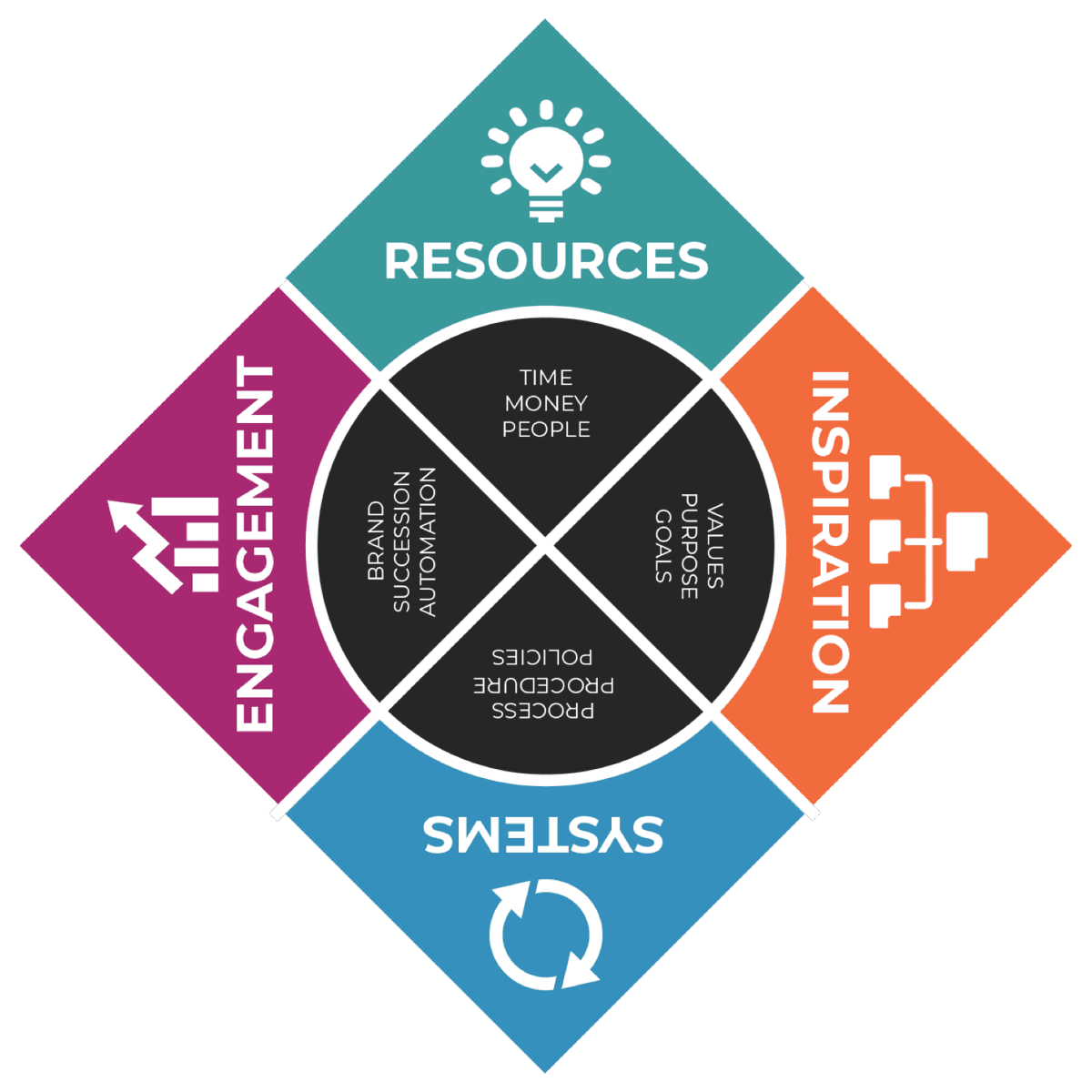
Resources · Topic 1 of 4
What is talent accountability?
By RISE Business Framework · Created by Gary Harper and Brandon McCurdy · Reviewed
Talent accountability means every person knows their role and every piece of work has a named owner. RISE builds it with four tools. An Organizational Chart sets structure and a Process Ownership Chart sets ownership. Process Commitment questions confirm buy-in, and a scored Succession Planning grid protects critical roles.
Key takeaways
- The Organizational Chart defines structure; the Process Ownership Chart defines who owns the work.
- Every core process gets a single accountable owner.
- Four commitment questions test each team member in each seat.
- Critical roles scoring above 10 on the succession grid are addressed immediately.
Talent Accountability in the RISE Business Framework
Talent Accountability is the first topic in the Resources quadrant of the RISE Business Framework. It answers a simple question: who owns what? The workbook draws it as a loop of structure, ownership, buy-in and continuity.
Companies that implement RISE work through four tools in order. They draw the Organizational Chart, map the Process Ownership Chart, ask the Process Commitment questions, and score every critical role for succession risk.
Why talent accountability matters
When roles are unclear, work falls between people. Tasks get done twice or not at all. Nobody can say who has authority over which area, so decisions stall at the top.
When no single person owns a process, nobody is accountable when it breaks. And when a critical role has no successor, one resignation can stop part of your business cold.
“Processes are the lifeblood of an organization, and a process ownership chart is the roadmap to efficient and accountable execution.”Gary Harper
The 4 tools of Talent Accountability
1 of 4
Organizational Chart
Define structure, roles and the chain of command so everyone knows who has authority over what.
2 of 4
Process Ownership Chart
A four-tier chart that names who innovates, leads, manages and owns each core process.
3 of 4
Process Commitment
Four questions asked of each team member to confirm they are committed to their seat.
4 of 4
Succession Planning
Score each critical role on five risk criteria and address any role totaling above 10 now.
How to build talent accountability with RISE
- 1
Draw the Organizational Chart
Start with the key seats at the top and work down. Show departments, the chain of command and who has authority over each area.
- 2
Map the Process Ownership Chart
Name who innovates, who leads, who manages and who owns each process. Give every core process one accountable owner.
- 3
Ask the commitment questions
Ask each team member the four Process Commitment questions about their seat. Check time horizon, role clarity, process clarity and engagement.
- 4
Score critical roles for succession
Rate each critical role 1-3 on five criteria. Total the scores and address any role above 10 immediately.
- 5
Update as you grow
Treat the charts as living documents. Revisit them when your team, roles or processes change.
Quick self-check
“We assign ownership for each process in the business to a single team member so accountability is clear.”
AI RISE Coach
Map your process owners with the AI RISE Coach
“Help me build a Process Ownership Chart so every core process in my business has a single owner.”
Frequently asked questions
What is talent accountability?
Talent accountability means each team member has a clear role and each process has one named owner. In RISE it covers the Organizational Chart, Process Ownership Chart, Process Commitment and Succession Planning.
What is the difference between an org chart and a process ownership chart?
An org chart shows structure and the chain of command. A Process Ownership Chart shows who innovates, leads, manages and owns each process, so the work itself has an accountable owner.
Should one person own each process?
Yes. The RISE Business Assessment asks whether you assign ownership for each process to a single team member so accountability is clear. Shared ownership usually means no ownership.
How do you hold employees accountable in a small business?
Start by making roles and process ownership explicit, then confirm each person understands and commits to their seat. RISE uses four commitment questions to check this seat by seat.
Related in RISE
- Talent Optimization (Resources)
- Process Execution (Systems)
- Leadership (Inspiration)
- The Resources quadrant
Further reading
- Succession Planning topic hub (Harvard Business Review)
- Engaging in Succession Planning toolkit (SHRM)