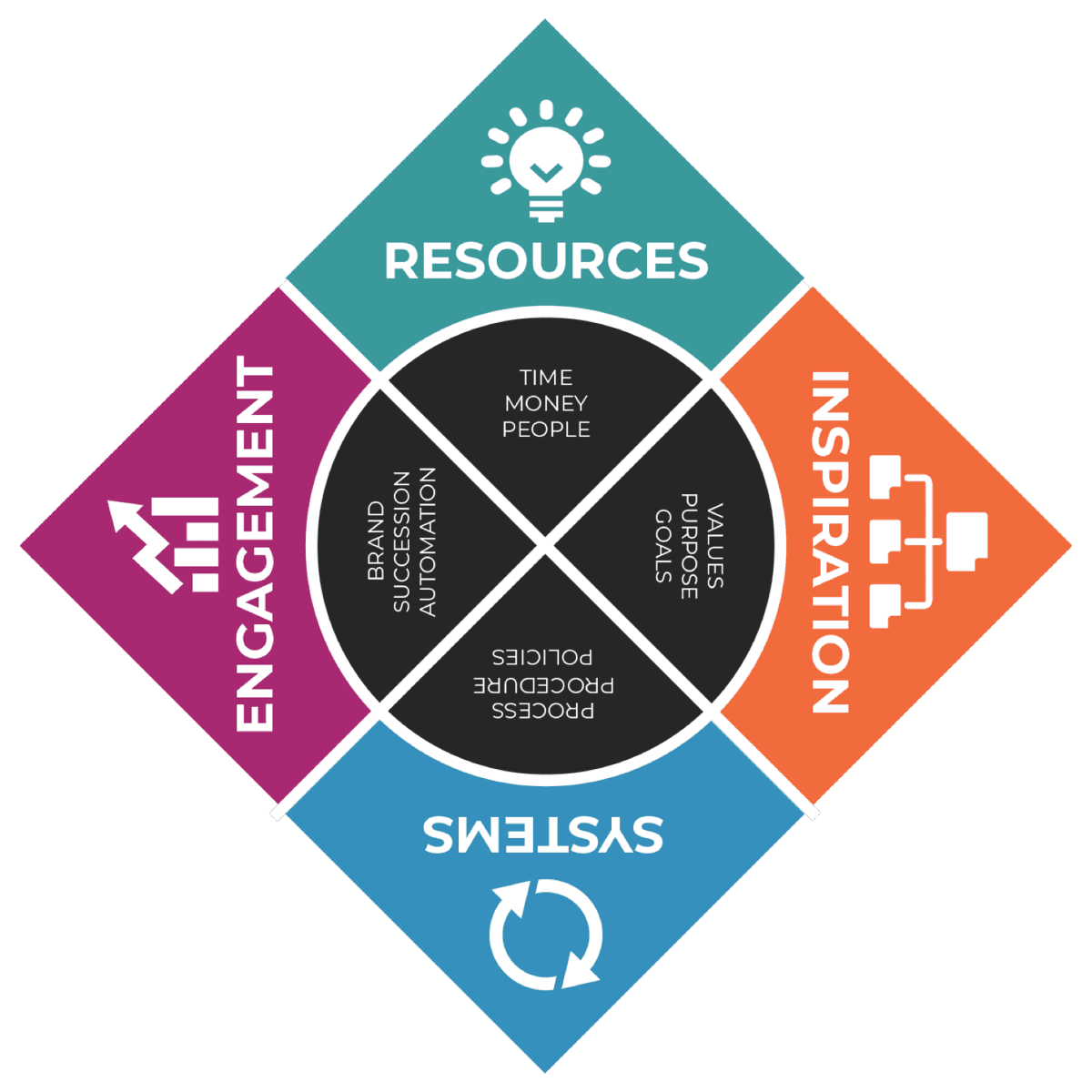
Inspiration · Topic 1 of 4
What is leadership?
By RISE Business Framework · Created by Gary Harper and Brandon McCurdy · Reviewed
Leadership is setting direction and moving people toward it. In RISE, it is the first pillar of the Inspiration quadrant. Leaders learn to challenge, inspire, model and empower, which encourages their people. They score themselves on separate leadership and management assessments, delegate based on what each person needs, and audit themselves every week.
Key takeaways
- RISE defines leadership with four actions: challenge, inspire, model and empower. Together they encourage the people you lead.
- Leadership and management are scored separately, with two 20-item assessments rated 1 to 3.
- Delegation starts by asking whether a person needs instruction, a budget, feedback or autonomy.
- A four-question Leadership Audit is run every week.
Leadership in the RISE Business Framework
Leadership is the first pillar of the Inspiration quadrant. It answers who sets direction and how people are moved toward it. RISE treats it as a skill you can measure and practice, not a personality trait.
The pillar has four parts. The Importance of Leadership model defines what good leaders do. Two assessments separate leadership from management. The Art of Delegation and a weekly Leadership Audit turn the ideas into habits.
Why leadership matters
Without clear leadership, a business runs on whoever is loudest or busiest. The owner manages tasks but never sets a direction people want to follow. Work gets done, but nobody knows why it matters.
Leadership that is never examined also drifts. Owners delegate too much too soon, or not at all. Strengths go unused and gaps go unnoticed because no one is measuring them.
“Leadership is the pulse, the heartbeat, the very soul of your enterprise. It's not about bossing people around; it's about lifting them up and directing collective energy toward a shared vision.”Gary Harper
The 4 tools of Leadership
1 of 4
Importance of Leadership
The RISE leadership model: challenge, inspire, model and empower, which together encourage the people you lead.
2 of 4
Leadership vs Management
Two parallel 20-item assessments that score your leadership and your management separately, so you can see where to grow.
3 of 4
Art of Delegation
Match each handoff to what the person needs: instruction, a budget, feedback or autonomy.
4 of 4
Leadership Audit
Four simple questions you answer every week to check how you are leading.
How to build leadership with RISE
- 1
Learn the five-part model
Study the Importance of Leadership model: challenge, inspire, model and empower, with encourage as the outcome at the center.
- 2
Take both assessments
Score yourself 1 to 3 on the 20 leadership statements and the 20 management statements. Total each one.
- 3
Compare the totals
Read the two totals side by side. Treat every low-scoring item as an opportunity for growth and training.
- 4
Delegate by need
For each task you hand off, decide whether the person needs instruction, a budget, feedback or autonomy. Agree on it together.
- 5
Audit yourself weekly
Answer the four Leadership Audit questions at the end of every week. Ask a trusted mentor or peer for an outside view.
AI RISE Coach
Run your Leadership Audit with the AI RISE Coach
“Walk me through this week's Leadership Audit and help me spot patterns in my answers.”
Frequently asked questions
What makes a good leader in a small business?
In RISE, a good leader challenges the status quo, inspires with a shared vision, models good behavior and empowers others. Done well, those four actions encourage people to act.
Can a business owner be a good manager but a weak leader?
Yes. That is why RISE scores leadership and management on two separate assessments. Many owners score higher on one than the other.
How often should a leader evaluate their own performance?
RISE recommends a short Leadership Audit every week. It uses four reflection questions about challenges, core values, your leadership style and what motivated your team.
Related in RISE
- Long-Term Vision (Inspiration)
- Talent Accountability (Resources)
- Effective Meetings (Systems)
- The Inspiration quadrant
Further reading
- What Leaders Really Do (Harvard Business Review)
- Management Time: Who's Got the Monkey? (Harvard Business Review)
- John Maxwell leadership blog (John Maxwell)