RISE vs Scaling Up: Comparing Two Growth Frameworks
· 8 min read · Systems quadrant
Part of the RISE Business Framework: The RISE Framework →
RISE and Scaling Up are both frameworks for running and growing a business with a clear strategy, quarterly priorities, a meeting rhythm and visible KPIs. Scaling Up, created by Verne Harnish, organizes the work around four decisions (People, Strategy, Execution and Cash) and is built for companies ready to scale. RISE organizes the work around four quadrants built in order (Resources, Inspiration, Systems and Engagement), starting with the financial and talent foundation and ending with branding, marketing, advertising and sales.
At a glance
| RISE Business Framework | Scaling Up | |
|---|---|---|
| What it is | A four-quadrant business operating framework with 64 teachable units | A "performance platform" built on the book Scaling Up (Rockefeller Habits 2.0) by Verne Harnish |
| Structure | 4 quadrants x 4 topics x 4 subtopics, built in order along the RISE Business Lifecycle | The Four Decisions: People, Strategy, Execution, Cash |
| Core planning tool | 3 Year Projection, 1 Year Target, 90 Day Sprint and The Four | One-Page Strategic Plan (BHAG, targets, quarterly priorities) |
| Finance | Pro formas, budgets, P&Ls and variance reports in the first quadrant | The Cash decision, with Cash Acceleration Strategies and the Power of One |
| Marketing & sales | A full quadrant (Engagement): branding, marketing, advertising, sales | Customer-focused strategy, including the 7 Strata strategy tool |
| People tools | Heart/Head/Hands/Feet assessments, 9-Box with prescribed actions, succession scoring | One-Page Personal Plan, Function Accountability Chart |
| Metrics | Stoplight Reports with four KPI types: purpose, profit, performance, process | KPIs and scoreboards; Rockefeller Habits Execution Checklist |
| Meeting rhythm | Four meeting types: culture, strategic, organizational, tactical | Daily huddles plus weekly, monthly, quarterly and annual meetings |
| Best fit | Owners building the foundation, then growth, in one sequenced model | Leadership teams of established firms focused on scaling |
What is Scaling Up?
Scaling Up is the methodology developed by Verne Harnish and taught in his book Scaling Up (Rockefeller Habits 2.0), which builds on his earlier book Mastering the Rockefeller Habits. Scaling Up describes itself as a "performance platform" and says it is aimed at "CEOs, founders, and leadership teams." Its own comparison page says it is "generally geared for larger firms (25 – 2500 employees)" as well as younger firms that want to scale more rapidly.
The method centers on the Four Decisions every company must get right: People, Strategy, Execution and Cash. Its published Growth Tools are grouped under those decisions:
- People: the One-Page Personal Plan (OPPP) and the Function Accountability Chart (FACe).
- Strategy: SWT, the 7 Strata, the One-Page Strategic Plan and the Vision Summary.
- Execution: Who What When (WWW) and the Rockefeller Habits Checklist.
- Cash: Cash Acceleration Strategies (CASh) and the Power of One.
The best-known tool is the One-Page Strategic Plan (OPSP), which captures a company's BHAG, targets and quarterly priorities on a single page. The Rockefeller Habits add execution discipline: a quarterly focus on the number-one priority, one accountable owner per area, daily and weekly KPIs, posted scoreboards, and a rhythm of daily huddles plus weekly, monthly, quarterly and annual meetings. The habits also ask companies to track customer feedback as closely as financial data.
Scaling Up's strengths are its rigorous strategy tools, its serious treatment of cash, and a meeting rhythm that keeps a growing organization in sync.
What is the RISE Business Framework?
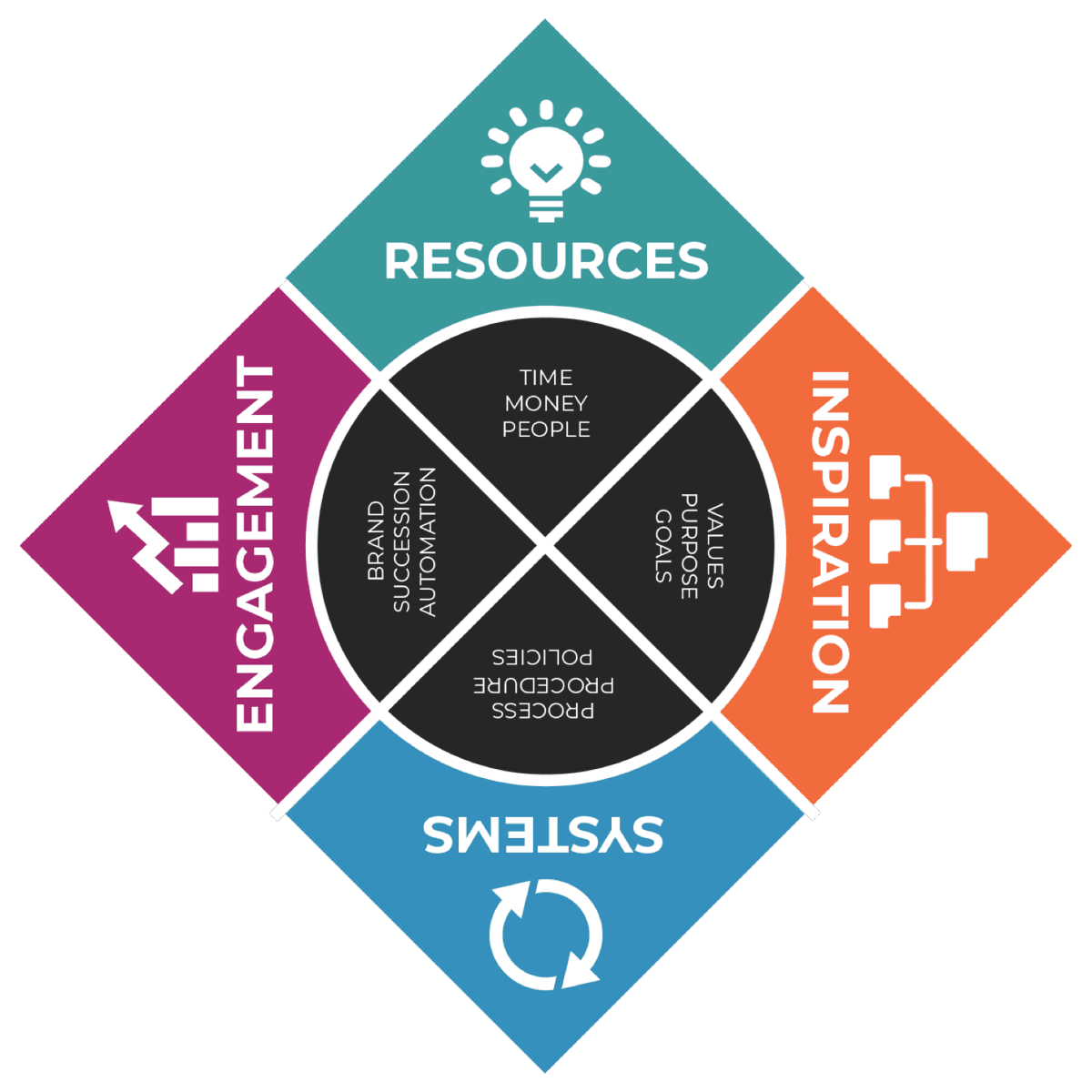
The RISE Business Framework was created by Gary Harper, Brandon McCurdy, Susan Harper and Austin McCurdy. It is a 4 x 4 x 4 system: four quadrants, four topics each, four subtopics per topic, for 64 teachable units.
- Resources: Talent Accountability, Talent Optimization, Talent Development and Finance.
- Inspiration: Leadership, Long-Term Vision, Culture and Short-Term Vision.
- Systems: Effective Meetings, Business Pipeline, Stoplight Reports and Process Execution.
- Engagement: Branding, Marketing, Advertising and Sales.
RISE pairs that map with the RISE Business Lifecycle and the RISE Growth Plateaus. The quadrants are built in order, and each plateau marks the point where one quadrant's work is complete and the next can begin.
Key similarities
Scaling Up and RISE agree on a lot.
- Long-term to short-term planning. Scaling Up runs from a BHAG through annual targets to quarterly priorities. RISE runs from Long-Term Vision through a 3 Year Projection and 1 Year Target to a 90 Day Sprint and The Four.
- A layered meeting rhythm. Scaling Up uses daily huddles and weekly, monthly, quarterly and annual meetings. RISE uses four meeting types (culture, strategic, organizational and tactical), including a daily process huddle and a weekly organizational meeting.
- One owner per area. Scaling Up's Rockefeller Habits call for one accountable owner per area; RISE uses a Process Ownership Chart so every core process has a single owner.
- Cash matters. Scaling Up has an entire Cash decision. RISE tracks the Cash Conversion Cycle in its Business Pipeline and treats cash on hand as a Key Profit Indicator.
- Core values and purpose. Both treat values and purpose as active management tools, not wall posters.
Key differences
1. Sequence versus simultaneous decisions
Scaling Up asks leaders to work on all four decisions as a company scales. RISE asks where the business sits on its Lifecycle and builds in order: Resources first, then Inspiration, Systems and finally Engagement. The free assessment shows which quadrant is holding the business back.
2. Different angles on finance
Scaling Up's Cash decision focuses on accelerating cash flow, with tools like Cash Acceleration Strategies and the Power of One for "what-if" scenarios. RISE puts the accounting foundation first: Finance covers pro formas, budgets, P&Ls and variance reports, and the Resources quadrant is complete only when the business is self-sustaining and profitable each month. For an owner who still lacks a reliable budget or monthly P&L, RISE starts one step earlier.
3. Marketing and sales as a full quadrant
Scaling Up handles market positioning through its Strategy decision and tools such as the 7 Strata. RISE gives go-to-market its own quadrant, Engagement, with topics for branding, marketing, advertising and sales, including product analysis, marketing plans, channel budgeting and a sales process. RISE also adds a gate: a business "earns the right to engage" once it scores 10 or higher (out of 12) in Resources, Inspiration and Systems.
4. Talent tools
Scaling Up's people tools include the One-Page Personal Plan and the Function Accountability Chart. RISE's people work runs through Talent Optimization (Heart, Head, Hands and Feet assessments), a 9-Box that pairs each cell with a prescribed action, and Talent Development from recruiting through recognition, plus scored succession planning.
5. KPIs sorted by type
Scaling Up asks every employee to report on one or two KPIs and to post scoreboards. RISE Stoplight Reports sort indicators into four types (purpose, profit, performance and process), each with its own owner, cadence and meeting.
Which is right for your business?
Choose Scaling Up if:
- You are an established company focused on rapid growth and want rigorous strategy tools like the One-Page Strategic Plan and 7 Strata.
- Cash flow acceleration is your top financial priority.
- You want a dense meeting rhythm with daily huddles across a larger organization.
Choose RISE if:
- You want budgets, P&Ls and variance reports in place before you push for growth.
- You want branding, marketing, advertising and sales inside the same framework as your vision, meetings and KPIs.
- You want a clear order of operations and a simple way to see which quadrant is your constraint.
- You want structured talent assessments and succession planning built in.
Consider using pieces together if:
- Your leadership team likes the One-Page Strategic Plan. It can sit alongside RISE's Short-Term Vision, with RISE's quadrants supplying the finance, talent, systems and Engagement work underneath it. Keep one set of quarterly priorities so the team is not tracking two lists.
How to try RISE
Take the free RISE Business Assessment. Rate 16 statements from 1 to 3, total each quadrant, then divide the overall total by 48 to find your company's RISE percentage. Your lowest quadrant points to your next step. Then explore the RISE Framework or ask the AI RISE Coach how a specific tool fits your business.
Frequently Asked Questions
What are the four decisions in Scaling Up?
People, Strategy, Execution and Cash. Scaling Up's tools, such as the One-Page Strategic Plan and the Rockefeller Habits Checklist, are organized under those four decisions.
What are the four quadrants of RISE?
Resources, Inspiration, Systems and Engagement. Each quadrant has four topics with four subtopics each, and they are built in that order along the RISE Business Lifecycle.
Is RISE a good alternative to Scaling Up for smaller companies?
RISE starts with the foundation (finance, talent and accountability) before growth, so it suits owners who are still building that base. Scaling Up describes itself as generally geared to larger firms and companies that want to scale quickly.
Which framework handles finance better?
They approach it differently. Scaling Up's Cash decision focuses on accelerating cash flow, while RISE starts with pro formas, budgets, P&Ls and variance reports and tracks the Cash Conversion Cycle as a profit indicator.
Can I use the One-Page Strategic Plan with RISE?
Yes. It can sit alongside RISE's Short-Term Vision, as long as the team keeps a single set of quarterly priorities.