RISE vs EOS: Which Business Operating System Fits You?
· 8 min read · Systems quadrant
Part of the RISE Business Framework: The RISE Framework →
RISE and EOS are both business operating systems that help a leadership team align on vision, track a handful of numbers, run a weekly meeting and finish quarterly priorities. The main difference is scope and sequence: EOS organizes a business around Six Key Components, while RISE organizes it around four quadrants built in order (Resources, Inspiration, Systems, Engagement), with finance in the first quadrant and branding, marketing, advertising and sales built into the framework itself. If you want a focused, widely documented leadership-team system, EOS is a strong choice; if you want one framework that also covers your financial foundation, talent tools and go-to-market, RISE is worth a close look.
At a glance
| RISE Business Framework | EOS (Entrepreneurial Operating System) | |
|---|---|---|
| What it is | A four-quadrant business operating framework with 64 teachable units | An operating system for entrepreneurial businesses, introduced in the book Traction |
| Structure | 4 quadrants x 4 topics x 4 subtopics, built in order along the RISE Business Lifecycle | Six Key Components: Vision, People, Data, Issues, Process, Traction |
| Finance | A full topic in the first quadrant: pro formas, budgets, P&Ls, variance reports | Revenue, profit and measurables appear in the 3-Year Picture, 1-Year Plan and Scorecard |
| Marketing & sales | A full quadrant (Engagement): branding, marketing, advertising, sales | Marketing Strategy on the V/TO: target market, Three Uniques, Proven Process, Guarantee |
| People tools | Heart/Head/Hands/Feet assessments, 9-Box with prescribed actions, succession scoring | Accountability Chart, GWC, People Analyzer |
| Metrics | Stoplight Reports with four KPI types: purpose, profit, performance, process | Scorecard of weekly Measurables |
| Meeting rhythm | Four meeting types: culture, strategic, organizational, tactical | Weekly 90-minute Level 10 Meeting plus quarterly and annual planning |
| Quarterly priorities | The Four and 90-day F.A.S.T. goals inside Short-Term Vision | Rocks: three to seven 90-day priorities |
| Best fit | Owners who want finance, people, systems and growth in one sequenced model | Leadership teams that want a proven, tightly scoped operating system |
What is EOS?
EOS, the Entrepreneurial Operating System, describes itself as "a complete, proven operating system for entrepreneurial businesses." It was developed by Gino Wickman and introduced publicly in his 2007 book Traction: Get a Grip on Your Business. EOS Worldwide says it is designed for privately held entrepreneurial companies with roughly 10 to 250 employees.
EOS is built around Six Key Components: Vision, People, Data, Issues, Process and Traction. Each component has a signature tool:
- Vision/Traction Organizer (V/TO): eight questions covering Core Values, Core Focus, 10-Year Target, Marketing Strategy, 3-Year Picture, 1-Year Plan, Quarterly Rocks and Issues.
- Accountability Chart: defines "who is accountable for what," with each seat checked against GWC (Gets it, Wants it, Capacity to do it).
- People Analyzer: combines Core Values and GWC into a systematic review.
- Scorecard: a handful of weekly Measurables.
- Rocks: the three to seven most important priorities for the current 90-day quarter.
- Level 10 Meeting: a weekly 90-minute leadership meeting with a set agenda, most of which is spent on IDS (Identify, Discuss, Solve).
- Three-Step Process Documenter: a simple way to document core processes.
Companies can self-implement EOS using the books and free tools, or work with a Professional EOS Implementer. EOS is well known, well documented and easy to start, and its tools are simple enough for an entire team to learn quickly. Those are real strengths.
What is the RISE Business Framework?
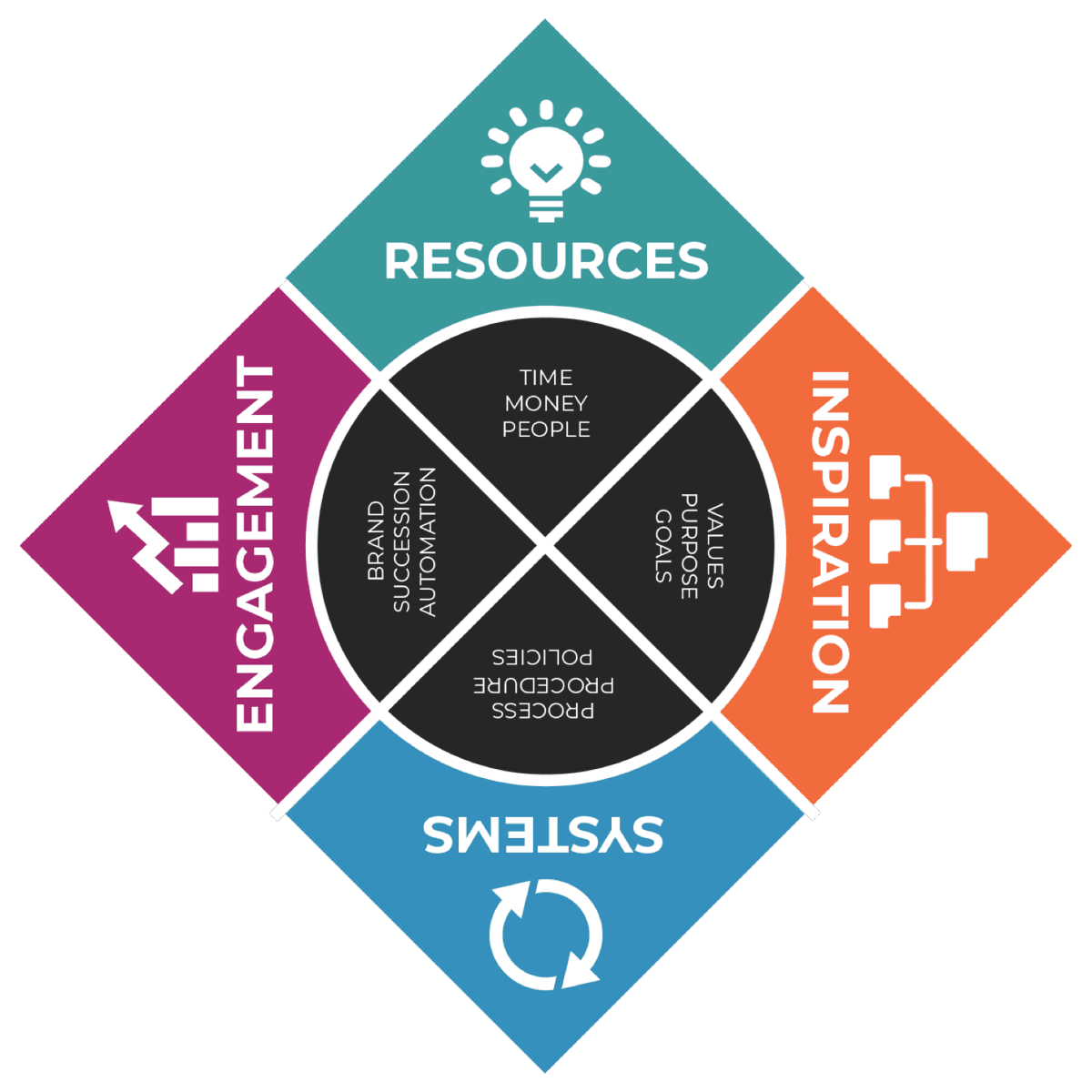
The RISE Business Framework was created by Gary Harper, Brandon McCurdy, Susan Harper and Austin McCurdy. It is a 4 x 4 x 4 system: four quadrants, each with four topics, each with four subtopics, for 64 teachable units.
- Resources: time, money and people. Talent Accountability, Talent Optimization, Talent Development and Finance.
- Inspiration: Leadership, Long-Term Vision, Culture and Short-Term Vision.
- Systems: Effective Meetings, Business Pipeline, Stoplight Reports and Process Execution.
- Engagement: Branding, Marketing, Advertising and Sales.
What makes RISE distinctive is the order. The RISE Business Lifecycle moves through the quadrants in sequence, and the RISE Growth Plateaus describe the flat stretch a business hits when one quadrant's work is done. In RISE, a plateau is a launching point for the next quadrant, not a failure.
Key similarities
RISE and EOS share more than they differ, and it is worth being honest about that.
- Vision cascade. EOS uses a 10-Year Target, 3-Year Picture and 1-Year Plan. RISE uses Long-Term Vision plus a 3 Year Projection, 1 Year Target and 90 Day Sprint.
- Quarterly priorities. EOS has Rocks. RISE has The Four: "What are the FOUR things that MUST happen over the next 90 days?"
- Core values. Both ask leadership to define core values and use them in people decisions.
- Clear ownership. EOS has the Accountability Chart. RISE has an Organizational Chart and a Process Ownership Chart so every core process has a single accountable owner.
- A weekly meeting and a scorecard. EOS has the Level 10 Meeting and Scorecard. RISE has a weekly Organizational Meeting with a RISE Issues List and Stoplight Reports.
- Documented processes. Both treat documented core processes as essential.
If your team already runs EOS well, much of that discipline carries straight into RISE.
Key differences
1. Finance is a foundation, not just a number
In EOS, revenue, profit and measurables show up in the V/TO and Scorecard. In RISE, Finance is a full topic in the very first quadrant, with four subtopics: pro formas, budgets, P&Ls and variance reports. The Resources quadrant is complete only when the business is self-sustaining, can pay its own expenses and makes a profit each month. For owners who are not yet confident in their numbers, that is a meaningful difference.
2. Marketing and sales are part of the framework
EOS includes a Marketing Strategy on the V/TO (target market, Three Uniques, Proven Process and Guarantee). RISE gives go-to-market an entire quadrant: Engagement, covering branding, marketing, advertising and sales. RISE also sets a gate: a business "earns the right to engage" by scoring 10 or higher (out of 12) in Resources, Inspiration and Systems on the RISE Business Assessment. The idea is to avoid pouring money into growth before the business can absorb it.
3. Deeper talent tools
EOS uses GWC and the People Analyzer to judge fit. RISE adds Talent Optimization through four assessments (Heart for desire, Head for behavior, Hands for skills, Feet for mobility), a 9-Box that pairs each cell with a prescribed action (for example "Star: promote them" or "Core Players: coach them"), and a scored succession planning worksheet for critical roles.
4. Four KPI types and four meeting types
The EOS Scorecard tracks weekly Measurables. RISE Stoplight Reports separate four kinds of indicators: Key Purpose Indicators, Key Profit Indicators, Key Performance Indicators and Key Process Indicators. Each is reviewed in its own meeting: culture meetings review purpose, strategic meetings review profit, organizational meetings review performance and tactical meetings review process. EOS centers its rhythm on the weekly Level 10 Meeting, with quarterly and annual planning sessions.
5. A sequence, not just a set of components
EOS works all Six Key Components at once. RISE asks where the business sits on the Lifecycle and builds the quadrants in order. The free assessment shows which quadrant is the current constraint.
Which is right for your business?
Choose EOS if:
- Your finances are already clean and your main problem is leadership alignment and accountability.
- You have a separate marketing and sales playbook you are happy with.
- You value a large community of practitioners and a widely read book.
Choose RISE if:
- You want budgets, P&Ls and variance reports built into the operating system from day one.
- You want branding, marketing, advertising and sales inside the same framework as your vision and meetings.
- You want structured talent tools beyond a fit check, including assessments and succession planning.
- You want a clear order of operations so you know what to build next.
Consider combining them if:
- You already run Level 10 Meetings and Rocks and want to add RISE's finance, talent and Engagement content. The concepts map closely (Rocks to The Four, Scorecard to Stoplight Reports), so a team can adopt RISE quadrant by quadrant without throwing away habits that already work.
How to try RISE
Start with the free RISE Business Assessment. You rate 16 statements from 1 to 3, total each quadrant, then divide the overall total by 48 to get your company's RISE percentage. Your lowest quadrant shows where the opportunity is. From there, explore the RISE Framework topic by topic, or ask the AI RISE Coach how a specific tool applies to your business.
Frequently Asked Questions
Is RISE an EOS alternative?
Yes. RISE is a complete business operating framework, so it can replace EOS. It covers the same ground (vision, quarterly priorities, a scorecard, a weekly meeting) and adds finance, talent assessments and a full marketing and sales quadrant.
What is the RISE equivalent of EOS Rocks?
The closest equivalent is The Four, the four things that must happen over the next 90 days, supported by 90-day F.A.S.T. goals in the 90 Day Sprint. Both sit inside a longer vision cascade.
Does EOS include marketing?
Yes. The EOS V/TO includes a Marketing Strategy with a target market, Three Uniques, a Proven Process and a Guarantee. RISE goes further by making branding, marketing, advertising and sales a full quadrant.
Can I use EOS and RISE together?
Many of the tools map closely, so a team running EOS can add RISE content such as finance, talent assessments and Engagement without abandoning its meeting habits. Most companies eventually standardize on one shared vocabulary to keep things simple.
How do I know which RISE quadrant to start with?
Take the free RISE Business Assessment. The quadrant with the lowest score is usually the current constraint, and RISE builds the quadrants in order from Resources to Engagement.