RISE vs OKRs: Goal-Setting Method or Operating System?
· 8 min read · Systems quadrant
Part of the RISE Business Framework: The RISE Framework →
OKRs (Objectives and Key Results) are a goal-setting method: you name what you want to achieve and the measurable results that prove you got there, usually each quarter. RISE is a full business operating framework that covers finance, people, vision, meetings, KPIs, processes and marketing and sales across four quadrants. So the choice is not really either-or: OKRs answer "what are our goals and how will we measure them?", while RISE answers "how should this whole business run, and what should we build next?" Many teams can use OKRs inside RISE's Short-Term Vision.
At a glance
| RISE Business Framework | OKRs (Objectives and Key Results) | |
|---|---|---|
| What it is | A four-quadrant business operating framework with 64 teachable units | A goal-setting method that pairs an Objective with measurable Key Results |
| Structure | 4 quadrants x 4 topics x 4 subtopics, built in order along the RISE Business Lifecycle | Typically one Objective with 3 to 5 Key Results, set at company, team or individual level |
| Planning horizon | 3 Year Projection, 1 Year Target, 90 Day Sprint and The Four | Usually a quarterly cycle, graded at the end |
| Finance | Pro formas, budgets, P&Ls and variance reports in the first quadrant | Not covered; financial targets can be written as Key Results |
| Marketing & sales | A full quadrant (Engagement): branding, marketing, advertising, sales | Not covered; marketing goals can be written as OKRs |
| People tools | Heart/Head/Hands/Feet assessments, 9-Box with prescribed actions, succession scoring | CFRs (Conversations, Feedback, Recognition) complement OKRs |
| Metrics | Stoplight Reports with four KPI types: purpose, profit, performance, process | Key Results scored at the end of each cycle, numerically or with a traffic light |
| Meeting rhythm | Four meeting types: culture, strategic, organizational, tactical | No prescribed meeting system; regular check-ins and grading per cycle |
| Best fit | Owners who want an end-to-end way to run and grow the business | Teams that already have an operating rhythm and want clearer, more ambitious goals |
What are OKRs?
OKR stands for Objectives and Key Results. According to What Matters, "An Objective is simply what is to be achieved, no more and no less," and effective Key Results are "specific, time-bound, and aggressive yet realistic." A Key Result must be verifiable: at the end of the cycle it was either met or not.
The method has a well-documented history. Andy Grove created it at Intel, where he called it "iMBOs," and taught it to John Doerr. Doerr named it OKRs and introduced it to Google's founders in 1999. Doerr later wrote Measure What Matters, which also introduces CFRs (Conversations, Feedback and Recognition) as the companion practice that keeps OKRs alive between check-ins.
A few common conventions:
- Typically one Objective with 3 to 5 Key Results.
- A quarterly cycle is the usual default, with grading at the end of each cycle.
- Committed vs. aspirational OKRs. Committed OKRs are expected to be fully achieved; aspirational OKRs (stretch goals or "moonshots") deliberately reach beyond what a team can do in one quarter.
- Cascading. Company-level OKRs can flow to departments, managers and individuals, who take ownership of supporting Key Results.
- Scoring with a number or a red, yellow and green traffic light.
What Matters describes OKRs as "a goal-setting tool" that helps track progress, create alignment and encourage engagement. Their strengths are clarity, ambition, focus and the habit of measuring outcomes instead of activity.
What is the RISE Business Framework?
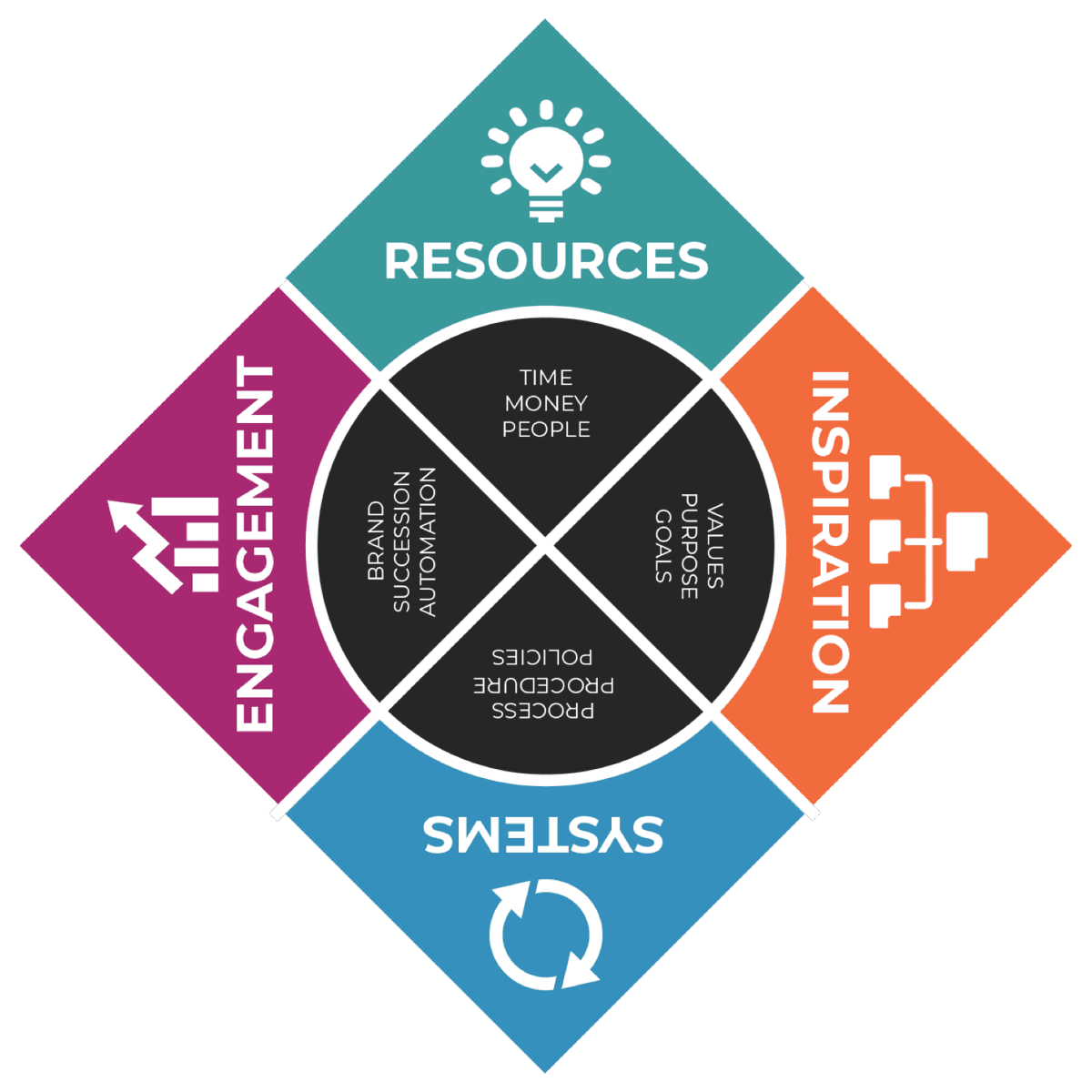
The RISE Business Framework was created by Gary Harper, Brandon McCurdy, Susan Harper and Austin McCurdy. It is a 4 x 4 x 4 system: four quadrants, four topics in each, four subtopics per topic, for 64 teachable units.
- Resources: Talent Accountability, Talent Optimization, Talent Development and Finance.
- Inspiration: Leadership, Long-Term Vision, Culture and Short-Term Vision.
- Systems: Effective Meetings, Business Pipeline, Stoplight Reports and Process Execution.
- Engagement: Branding, Marketing, Advertising and Sales.
The RISE Business Lifecycle builds those quadrants in order, and the RISE Growth Plateaus mark the points where one quadrant's work is done and the next quadrant becomes the lever for growth.
Key similarities
OKRs and RISE share a few important instincts.
- Quarterly focus. OKRs usually run on a quarter. RISE uses a 90 Day Sprint with F.A.S.T. goals and The Four: "What are the FOUR things that MUST happen over the next 90 days?"
- Measurable outcomes. Key Results must be verifiable. RISE Stoplight Reports give every indicator an owner and a target.
- Traffic-light thinking. OKRs are often scored red, yellow and green. RISE's reporting is literally named for the stoplight.
- Alignment from top to bottom. Cascading OKRs connect company goals to team goals. RISE connects a long-term purpose to a 3 Year Projection, 1 Year Target and quarterly priorities.
- The human side. OKRs pair with CFRs. RISE pairs its goals with leadership, culture and talent development work.
Key differences
1. A goal method versus an operating framework
OKRs tell you how to write and track goals. They do not prescribe how to build a budget, structure a team, run meetings, document processes or market the business. RISE does: its 64 units cover finance, talent, leadership, culture, meetings, pipeline, KPIs, process execution, branding, marketing, advertising and sales.
2. What you measure
OKRs measure progress toward this cycle's goals. RISE also measures the ongoing health of the business through four KPI types: Key Purpose Indicators, Key Profit Indicators, Key Performance Indicators and Key Process Indicators. Many of these are standing measures (for example, cash conversion cycle or unpaid invoices) rather than goals that change each quarter.
3. Meeting rhythm
OKRs recommend regular check-ins and end-of-cycle grading but do not define a full meeting system. RISE defines four meeting types (culture, strategic, organizational and tactical), each paired with one KPI type, from a daily process huddle to quarterly strategic and culture meetings.
4. Finance and go-to-market built in
You can write a revenue or marketing OKR, but OKRs do not teach the underlying work. RISE puts Finance (pro formas, budgets, P&Ls and variance reports) in its first quadrant and gives marketing and sales a whole quadrant, Engagement. RISE also says a business "earns the right to engage" by scoring 10 or higher (out of 12) in Resources, Inspiration and Systems.
5. What to work on next
OKRs assume you already know which goals matter most. RISE's Lifecycle and the free RISE Business Assessment help you find the quadrant that is currently holding the business back, so your goals target the real constraint.
Which is right for your business?
Use OKRs on their own if:
- You already have solid finances, clear roles, a meeting rhythm and a working sales process, and you mainly want clearer, more ambitious goals.
- You are a team inside a larger organization that already has its own operating system.
Use RISE if:
- You need more than goals: a budget and P&L you trust, clear process ownership, documented systems and a plan for marketing and sales.
- You want people tools such as Heart, Head, Hands and Feet assessments, a 9-Box with prescribed actions and succession planning.
- You want a clear order of operations for growing the business.
Use both together if:
- You like the OKR format. OKRs fit naturally inside RISE's Short-Term Vision: your 1 Year Target and 90 Day Sprint set the direction, and each of The Four can be written as an Objective with 3 to 5 Key Results. Stoplight Reports keep tracking the standing health of the business, while OKRs track this quarter's push. Just keep one list of quarterly priorities so the team is not managing two.
How to try RISE
Start with the free RISE Business Assessment. Rate 16 statements from 1 to 3, total each quadrant, then divide the overall total by 48 to get your company's RISE percentage. Your lowest quadrant is a good place to aim your next set of goals. Then explore the RISE Framework or ask the AI RISE Coach to help you turn your 90 Day Sprint into measurable goals.
Frequently Asked Questions
Are OKRs a business operating system?
OKRs are a goal-setting method, not a full operating system. They define objectives and measurable key results but do not prescribe finance, people, meeting or marketing practices, which is what a framework like RISE covers.
Can I use OKRs with RISE?
Yes. OKRs fit inside RISE's Short-Term Vision, where each of The Four quarterly priorities can be written as an Objective with 3 to 5 Key Results, while Stoplight Reports track ongoing business health.
What is the difference between OKRs and KPIs?
OKRs set goals for a cycle and measure progress toward them. KPIs track the ongoing health of the business. RISE uses four KPI types (purpose, profit, performance and process) in its Stoplight Reports.
Who created OKRs?
Andy Grove created the method at Intel, and John Doerr named it OKRs and introduced it to Google's founders in 1999. His book Measure What Matters covers the method in depth.
Where should a small business start: OKRs or RISE?
If you are unsure where your business stands, start with the free RISE Business Assessment. It shows which quadrant is your constraint, which makes any goals you set, including OKRs, more focused.